← Back to Blog
BRACES

How do braces actually work?

Educational article · 6 min read · Klinik Pergigian Hazwan & Alia

Ever wondered how a thin wire and a few small brackets can actually move teeth? The short answer: gentle pressure, kept up over time, in a direction your dentist has planned. Here is what is really going on, part by part.

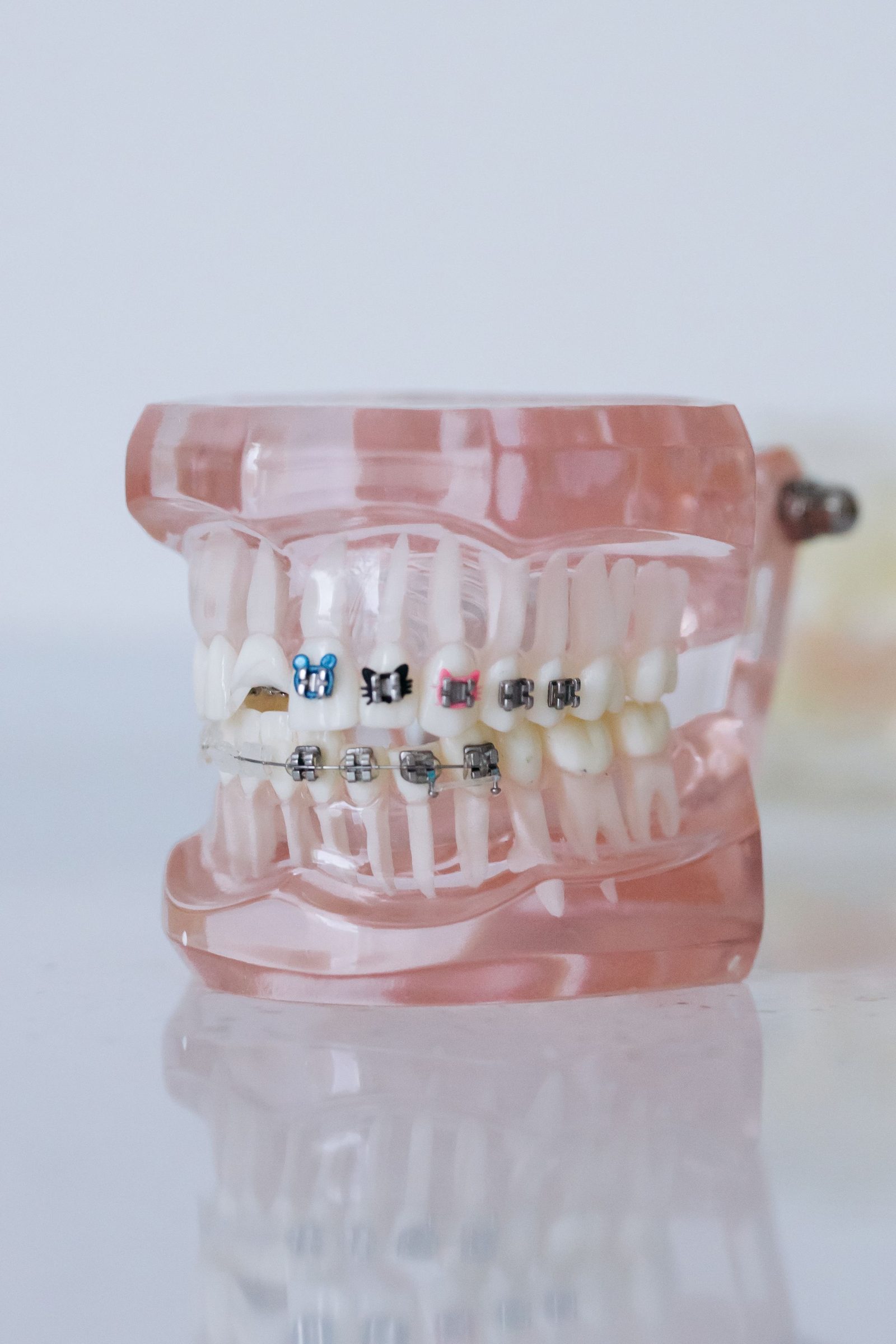
Teeth with fixed braces, brackets and archwire
Fixed braces: a small bracket on each tooth, joined by one continuous archwire.

All articles →

The biology

Why teeth can move at all

Your teeth are not fused to the jawbone. Each one sits in its own socket, cushioned and held by a thin band of fibres called the periodontal ligament. That ligament is what makes movement possible.

1 2 3 4
  • 1Gentle pressure. The archwire pushes the tooth in one planned direction. Light and constant works better than hard and sudden.
  • 2Periodontal ligament. The fibres between tooth and bone stretch on one side and compress on the other, and they signal the bone to change.
  • 3Bone makes way. On the pressure side, bone is slowly resorbed so the tooth has somewhere to move into.
  • 4New bone forms. On the opposite side, fresh bone fills in behind the tooth and holds the new position.

This is a natural, everyday process. It just takes time. In most people a tooth moves roughly one millimetre a month, which is why treatment is measured in months rather than weeks. Pushing harder does not move a tooth faster, it only makes it sore.

~1mm
typical tooth movement per month
4 to 6
weeks between adjustment visits
18 to 24
months for most cases

The hardware

The parts of a fixed brace

A fixed brace looks complicated, but it is really only four things working together.

1 2 3 4
  • 1Bracket. A small square bonded to the front of each tooth. It is the handle the wire holds on to, and the shape of its slot decides which way that tooth is guided.
  • 2Archwire. One wire running through every bracket. It is shaped to the arch your teeth should end up in, and as it tries to return to that shape it carries the teeth along with it.
  • 3Elastic tie (ligature). The small rubber ring that keeps the wire seated in the slot. Yes, you get to pick the colour. Self⁠-⁠ligating brackets use a built⁠-⁠in clip instead of a tie.
  • 4Band. A metal ring cemented around a back tooth. It anchors the whole system, because the back teeth take the pull coming from the wire.
Brackets come in a few types. Metal and self⁠-⁠ligating are the most common. Ceramic (tooth⁠-⁠coloured) and lingual (fitted behind the teeth) are the clear & hidden options if you would rather they were not obvious. All five types, including gold, are explained on the braces page.

Stage by stage

The four stages of treatment

Braces do not do everything at once. The work is ordered, and each stage sets up the one after it.

1

Early alignment

Crooked teeth start lining up into a proper arch. A thin, springy wire does most of the work here. This is the stage where you notice the biggest visible change.

2

Closing the spaces

Gaps, including any left behind by extractions, are closed bit by bit using a firmer wire with small springs or elastics.

3

Fine⁠-⁠tuning the bite

Each tooth is adjusted so the upper and lower sets meet properly. The changes are small, but they matter for chewing and for long⁠-⁠term stability.

4

Retainer

Once the braces come off, a retainer holds everything in its new position while the bone settles around it. This part is not optional. Teeth drift back if the retainer stays in the drawer.

The retainer is included in both of our braces payment plans, along with extractions if you need them, scaling, and rebonding if a bracket comes off. See pricing for full details.

Every 4 to 6 weeks

What happens at an adjustment visit

The appointment is usually short, often 20 to 30 minutes. This is the normal order of things.

  • 1A quick check. The dentist looks at how far the teeth have moved since the last visit and compares that with the plan.
  • 2The ties come off. The elastic ties are removed so the archwire can be lifted out. With self⁠-⁠ligating brackets, the clips simply open.
  • 3Teeth and brackets are cleaned. Any plaque built up around the brackets is cleared while the wire is out.
  • 4A new wire, or the same one adjusted. Early in treatment the wire is changed to a slightly thicker or stiffer one. Later it may just be re⁠-⁠bent or re⁠-⁠tied.
  • 5Extras if needed. Small springs, elastics running between the upper and lower teeth, or a repair if a bracket has come loose.
  • 6The next appointment. Usually 4 to 6 weeks later, so the pressure stays in the range that actually moves teeth.

Once the new wire is in, the pressure builds again and the teeth start moving. That pressure fades over the following weeks, which is exactly why the visits are spaced the way they are. Miss appointments and the movement simply stalls, so turning up is honestly the biggest thing you can do to keep treatment on track.

It is normal for teeth to feel tender or a little achy for two or three days after an adjustment. Soft food helps. If something is sharp, poking your cheek, or genuinely painful, call the clinic instead of waiting for the next appointment.
How long

How long does it all take?

Most cases run 18 to 24 months. Mild overcrowding can be quicker. Complicated bites take longer. The table below shows a typical pattern, not a promise.

Stage Typical duration What you notice
Early alignment 3 to 6 months The fastest visible change
Closing the spaces 6 to 12 months Gaps shrink slowly, month by month
Fine⁠-⁠tuning the bite 3 to 6 months Small changes, the bite starts to feel right
Retainer Long term, after the braces come off Worn as instructed to hold the position

Every case is different, and no dentist can name an exact finish date at the start. Age, how far the teeth need to travel, whether extractions are needed, gum health and how consistently you attend all shift the timeline. Your dentist will give you an honest estimate after examining your teeth and X⁠-⁠rays, not before.

Common questions

Three things patients ask us

Does it hurt?
Fitting the braces itself is not painful. The tenderness comes afterwards, usually for two or three days following each adjustment, and it feels more like pressure than sharp pain. Most people get through it with soft food.
What if a bracket comes off?
It happens, usually because of hard or sticky food. Call the clinic and we will bond it back on. Rebonding is included in both braces payment plans, so there is no extra charge for it.
Can I still eat normally?
Mostly, yes. Avoid hard nuts, ice, sticky sweets and anything you would tear at with your front teeth. Cut apples into pieces and slice corn off the cob rather than biting straight in.

For the daily routine, brushing around brackets and what to keep in your bag, read our guide on looking after braces.

Questions about your own teeth?

Send us a WhatsApp message, or book an examination, and the dentist will talk you through what your teeth actually need.

Klinik Pergigian Hazwan & Alia, Lot 2763, Tingkat 1, Jalan Changkat Permata, Taman Permata, 53300 Kuala Lumpur. Phone 03⁠-⁠4108 6005, WhatsApp 012⁠-⁠2866 458.

This article is for educational purposes only. It does not replace an examination, a diagnosis or advice from your own dentist. Every mouth is different, and the right treatment for you can only be decided after a proper examination.